
WE REALLY NEED TO ASK OURSELVES;
Why collect dirty recycling only to have it go to material repositories?

WHAT IS THE CURRENT STATE OF MATERIAL COLLECTION?
Single-stream recycling is prevalent across the U.S. with a scattering of communities still holding on to their original dual-stream collection programs. With China and other countries no longer accepting our dirty single-stream material, community leaders across the country are turning to dual-stream collection methods to decrease contamination.
SINGLE-STREAM vs DUAL-STREAM
SINGLE-STREAM COLLECTION
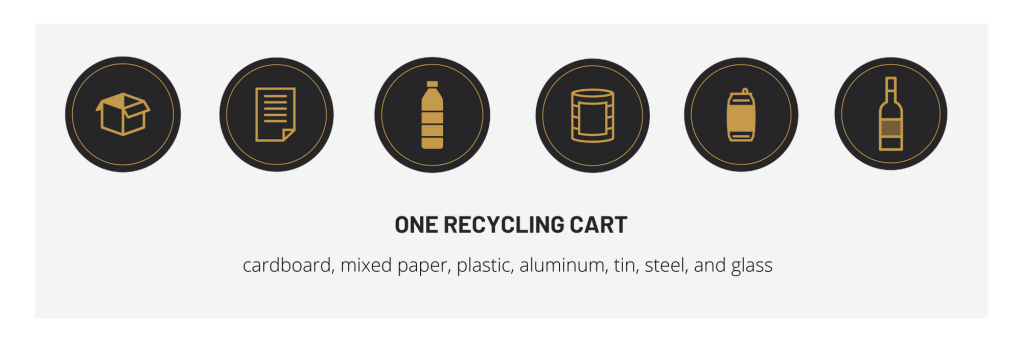
- One residential curbside cart.
- Resident costs ranges between $4 – $10 per month.
- High contamination rates from glass and wish-cycling.
- Contaminated material / loads head to material repositories.
- Considered the “convenient” option.
DUAL-STREAM COLLECTION
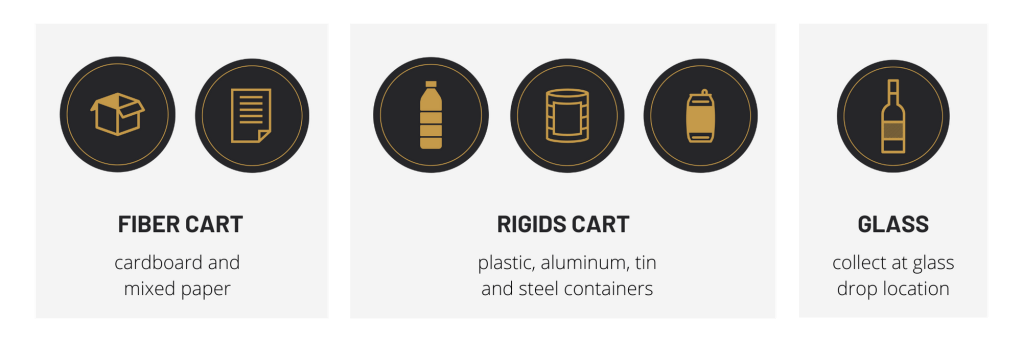
- Two residential curbside carts ( FIBER + RIGIDS ).
- Glass drop locations throughout communities.
- Resident costs ranges between $2.50 – $4.00 per month per cart.
- Low contamination rates.
- Requires some “self-sorting” from residents.
WHY DO WE NEED TO CLEAN THE RECYCLING STREAM?
There are few buyers for dirty recyclable material. Making efforts to clean the recycling streams at the collection point increases value in the marketplace.
WHERE IS CONTAMINATION HAPPENING AND WHERE IS THE OPPORTUNITY TO DECREASE CONTAMINATION?
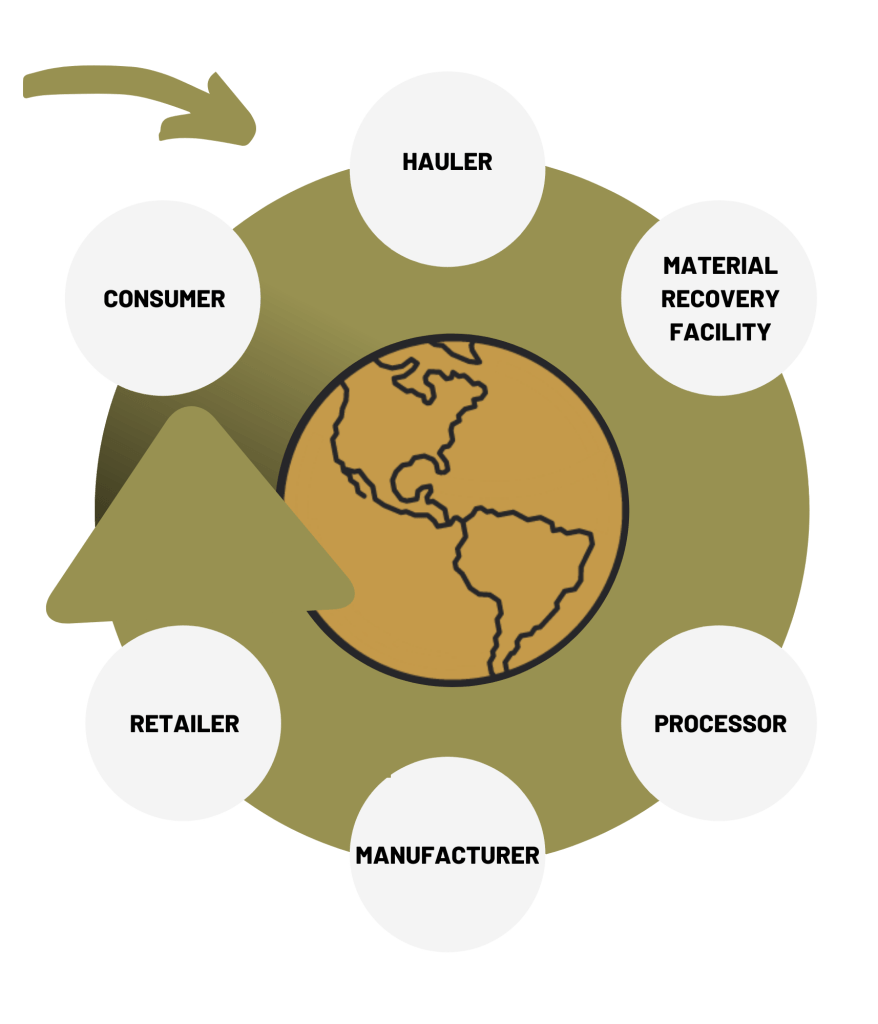
WHAT ARE COMMON CONTAMINANTS IN MATERIAL STREAMS?
- Glass containers and broken glass.
- Plastic bags and plastic wrap.
- Food and food residue.
- Diapers and clothing.
- Dirty food containers and greasy pizza boxes.

HOW CAN WE CLEAN THE RECYCLING STREAM?
The simple solution is to separate materials at the collection point to minimize contamination in each material stream. Dual-stream recycling and drop location collection yield the least contamination.
DUAL-STREAM LEGISLATION
Below is a list of legislation promoting Dual-Stream collection methods in the U.S.
WHO’S UTILIZING DUAL-STREAM COLLECTION METHODS?
Below is a list of some communities in the U.S. utilizing Dual-Stream collection methods.
- Berkeley, CA
- Kingston, NY
- St. Peters, MO
- Milpitas, CA
- Brookhaven, NY
- Corte Madera, CA
- Huntington, NY
- Lake Worth, FL
- Long Beach, NY
- Emmet County, MI
- Smithtown, NY
- Mountain View, CA
- Montgomery County, MD
- Wilkes-Barre, PN
- Sunnyvale, CA
- Hoboken, NJ
MATERIAL MANAGEMENT LANGUAGE TO KNOW
CIRCULAR ECONOMY: (also referred to as “circularity“) is an economic system aimed at eliminating waste and the continual use of resources. Circular systems employ reuse, sharing, repair, refurbishment, remanufacturing, recycling, and upcycling to create a closed-loop system, minimizing the use of resource inputs and the creation of waste, pollution and carbon emissions.
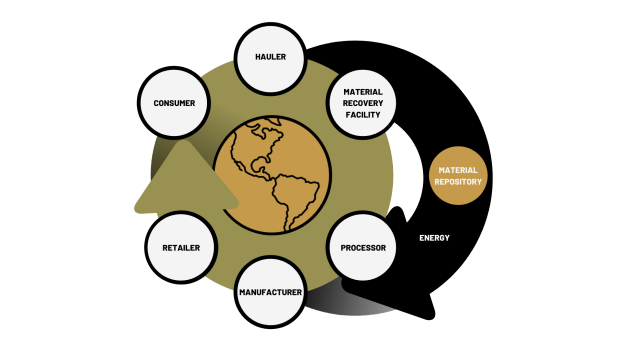
LINEAR ECONOMY: “take, make, dispose” model of production.
HOW IS MATERIAL COLLECTED FOR RECYCLING
DROP-SITE COLLECTION : is a recycling collection option that requires residents bring pre-sorted materials to a drop collection location or a materials management facility. Drop-sites may be manned or unmanned.
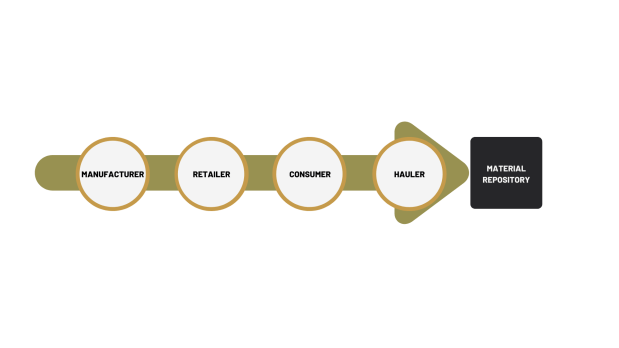
CURBSIDE COLLECTION : is a service provided to households for the disposal of Refuse. In this service, trucks collect waste and deliver it to either a repository or a recycling plant where it is sorted and processed for reuse. Single-stream and dual-stream collection are the two common collection methodologies utilized in curbside recycling collection in the U.S.
CURBSIDE COLLECTION OPTIONS
SINGLE-STREAM: (also known as “fully commingled” or “single-sort“) recycling refers to a system in which all paper fibers, plastics, metals, and other containers are mixed in a collection truck, instead of being sorted by the depositor into separate commodities (newspaper, paperboard, corrugated fiberboard, plastic, glass, etc.) and handled separately throughout the collection process. In single-stream, both the collection and processing systems are designed to handle this fully commingled mixture of recyclables, with materials being separated for reuse at a materials recovery facility (MRF).
DUAL-STREAM: (also referred to as “source separated recycling“) This means keeping the fiber component (paper and cardboard ) separate from containers, including glass and plastic containers and cans.
OTHER TERMS TO KNOW
BIODEGRADABLE : (of a substance or object) capable of being decomposed by bacteria or other living organisms.
BOTTLE BILL : any of several US state laws that require deposits to be paid on beverages sold in recyclable bottles and cans.
COLLECTION RATE : the number of people signed up for recycling services.
CONTAMINATION RATE : occurs when materials are sorted into the wrong recycling bin (placing a glass bottle into a mixed paper recycling bin for example), or when materials are not properly cleaned, such as when food residue remains on a container.
COMPOSTING : is an aerobic method (meaning that it requires the presence of air) of decomposing organic solid wastes. It can therefore be used to recycle organic material. The process involves decomposition of organic material into a humus-like material, known as compost, which is a good fertilizer for plants
DIVERSION RATE : is a calculation explaining the amount of waste that is diverted away from material repositories.
GREEN WASHING : also called “green sheen“, is a form of marketing spin in which green PR (green values) and green marketing are deceptively used to persuade the public that an organization’s products, aims and policies are environmentally friendly.
LEACHATE : formed when rain water filters through wastes placed in a material repository. When this liquid comes in contact with buried wastes, it leaches, or draws out, chemicals or constituents from those wastes. also known as materials reclamation facility or materials recycling facility, solid-waste management plant that processes recyclable materials to sell to manufacturers as raw materials for new products
MATERIAL RECOVERY FACILITY : (MRF) also known as materials reclamation facility or materials recycling facility, solid-waste management plant that processes recyclable materials to sell to manufacturers as raw materials for new products.
MATERIAL REPOSITORY : is a modern disposal site that manages waste through the use of technology to protect the environment.
MUNICIPAL SOLID WASTE : (MSW) more commonly known as trash or garbage—consists of everyday items we use and then throw away, such as product packaging, grass clippings, furniture, clothing, bottles, food scraps, newspapers, appliances, paint, and batteries.
POST-CONSUMER CONTENT : a material or finished product that has served its intended use and has been dis-carded for disposal or recovery, having completed its life as a consumer item.
RECYCLE : return (material) to a previous stage in a cyclic process.
RECYCLED-CONTENT PRODUCT : portion of materials used in a product that have been diverted from the solid waste stream.
RECYCLE RATE : is one of the most widely used indicators for monitoring progress in waste recycling and resource-saving activities. The recycling rate is calculated as the proportional value (%) of waste recycled from the total waste generated.
RECYCLABLE PRODUCT : means those materials which are capable of being recycled and which would otherwise be processed or disposed of as solid waste.
REDUCE : to use less.
REUSE : to use again.
UPCYCLE : reuse (discarded objects or material) in such a way as to create a product of higher quality or value than the original.
WISH-CYCLING : the practice of tossing questionable items in the recycling bin, hoping they can be recycled, often contaminating the entire load.
 Presidio Environmental